Communication Passport Information Sheet
The communication passport is a unique individual wellbeing record. Although the communication passport can support autistic people, in particular, it is designed for the use of all people who may require ongoing care and support. We understand that it could be difficult and tiring to keep those involved in your care updated. Therefore, the communication passport is intended to provide healthcare professionals with important information about you when they are assessing or treating you.
We have developed two versions a one-page version and an extended ‘Wellbeing Communication Passport’ (see images of front pages below). All patients have a choice on what version they want to fill in. Patients are also reminded that although it will be great if they fill in all sections, this is not a must and it is optional to fill in the sections.
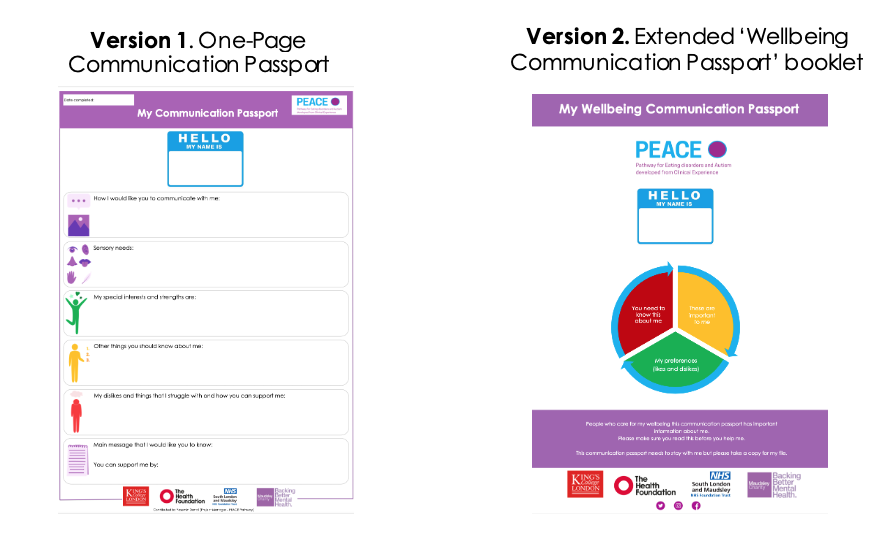
The communication passport should stay with the patient and if possible, staff should ensure that an electronic copy is uploaded on the IT system they use, and a hard copy is kept in the nursing office. Patients can review or change their goals or any section whenever they want but please consider sending the updated versions to those involved in your care.
You might find these interesting too!
A gentle workbook created by an anonymous parent author and shared with the PEACE Pathway team. This resource offers practical, neurodivergent-inclusive support for people experiencing eating difficulties, and for families or supporters navigating the waiting period before specialist care.
A neurodiversity-informed resource developed by the PEACE Plus Pathway to support clinicians working with individuals experiencing eating disorders and co-occurring autism and/or ADHD. The guide provides practical recommendations for adapting care, improving engagement, and delivering more accessible and person-centred treatment.
Join us online on 20 May 2026 for the PEACE Pathway Conference: Neurodiversity and Eating Disorders. The conference will explore the evolution of the PEACE Pathway toward a neurodivergent-informed service model and share insights from clinical practice, research, and co-production within eating disorder services.